
Harper Hayes · 8 September 2026
Navigating Data Resilience Strategies in Specialized Note Platforms for Long-Term User Engagement
Specialized note platforms have expanded their core functions beyond simple text capture to include layered data resilience measures that support sustained user participation over extended periods, and these measures address risks such as hardware failure, cyber incidents, and accidental deletion while maintaining continuous access for individuals and teams alike.
Platform developers integrate automated versioning systems that record every change, allowing restoration to prior states without manual intervention, and this capability proves especially useful in collaborative environments where multiple contributors edit the same documents simultaneously.
Core Components of Data Resilience Frameworks
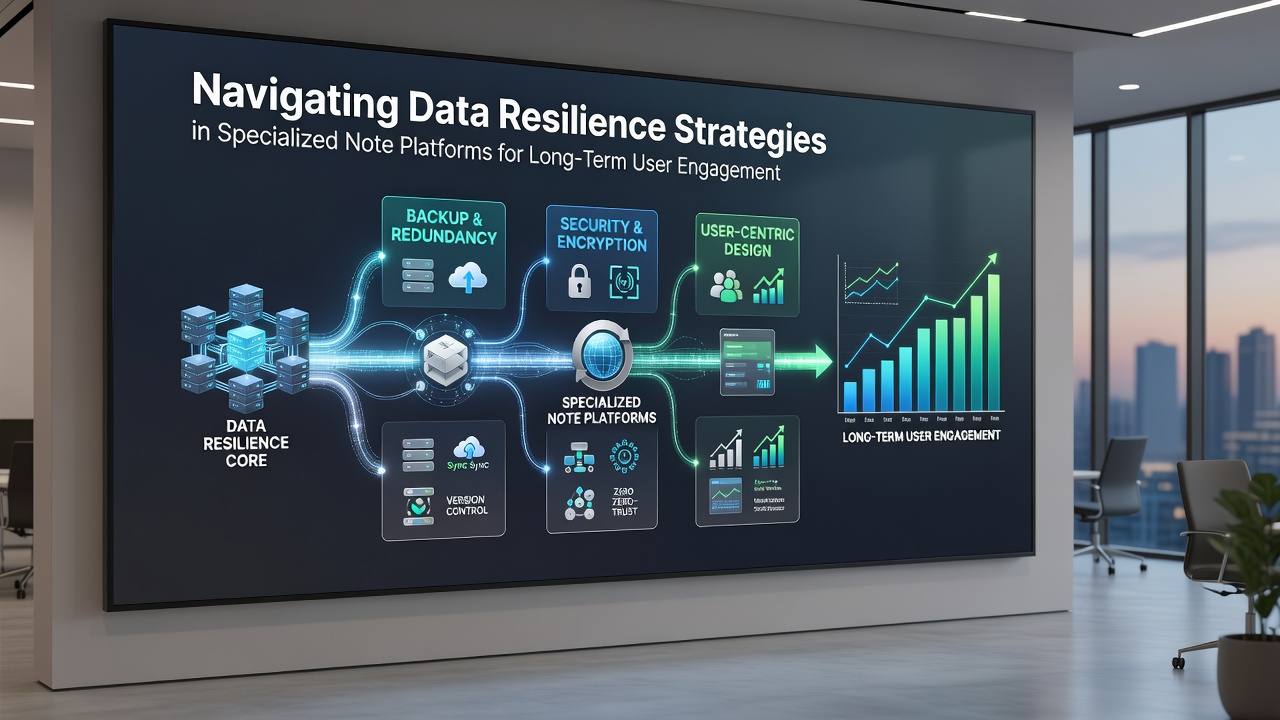
Redundancy forms the foundation of these frameworks, with providers distributing copies across geographically separated servers so that localized disruptions do not interrupt service continuity, while encryption protocols applied at rest and in transit protect stored content from unauthorized access during routine operations or recovery events.
Regular integrity checks scan stored notes for corruption, triggering alerts and repairs before users encounter issues, and these automated processes run on schedules that balance system load with the need for up-to-date verification.
Recovery Mechanisms and Testing Protocols
Disaster recovery plans specify recovery time objectives and recovery point objectives that dictate how quickly platforms restore access and how much recent data remains intact after an incident, and independent audits conducted by third-party firms verify that these targets remain achievable under simulated failure conditions.
One research initiative at a Canadian institution examined recovery performance across several note platforms and found that those employing multi-region replication achieved faster restoration compared with single-site configurations, according to findings published in 2025.
Users benefit when platforms offer self-service recovery tools that let individuals retrieve deleted items within defined windows, often extending to 90 days or more depending on subscription level, while enterprise tiers include dedicated support channels for complex restorations that involve large datasets.
Connection Between Resilience Measures and Sustained Participation
Long-term engagement correlates with user confidence that notes remain available and unaltered across years of use, and platform analytics indicate that accounts with access to advanced resilience features demonstrate higher retention rates after the first twelve months compared with basic accounts.
September 2026 marks the scheduled release of updated guidelines from the Australian Cyber Security Centre that emphasize continuous validation of backup integrity for cloud-based productivity services, and note platform operators have begun aligning their testing schedules with these forthcoming recommendations to maintain compliance.
Observers note that transparent communication about resilience features, delivered through in-app notifications and documentation, encourages users to explore advanced settings rather than default configurations, which in turn reduces support ticket volume related to data concerns.
Implementation Approaches Across Different Scales
Smaller platforms often rely on established cloud infrastructure providers to handle redundancy and failover, whereas larger services develop proprietary orchestration layers that coordinate replication across hybrid environments combining on-premises storage with public cloud resources.
Industry reports from the European Digital Infrastructure Consortium highlight that organizations adopting standardized resilience benchmarks experience fewer incidents that affect end-user productivity, and these benchmarks include requirements for documented rollback procedures and regular tabletop exercises involving cross-functional teams.
Training modules embedded within note platforms teach users how to enable two-factor authentication and configure export schedules, actions that complement platform-level protections by giving individuals additional control over their content lifecycle.
Emerging Trends and Measurement Practices
Analytics dashboards now track resilience-related metrics such as successful recovery rates and average time to restore, presenting these figures alongside engagement statistics so administrators can identify correlations between system reliability and continued platform usage.
Researchers continue to evaluate how encryption key management practices influence both security posture and recovery speed, with particular attention to zero-knowledge architectures that limit platform access to user data while still enabling automated backups through client-side processing.
What's interesting is the growing adoption of immutable storage snapshots that prevent even platform administrators from altering historical versions, a technique that strengthens audit trails and supports regulatory requirements in sectors handling sensitive information.
Conclusion
Data resilience strategies in specialized note platforms encompass redundancy, encryption, automated testing, and user-accessible recovery tools that collectively support uninterrupted access and foster continued participation over time, and ongoing alignment with evolving standards ensures these measures remain effective as usage patterns and threat landscapes shift.